
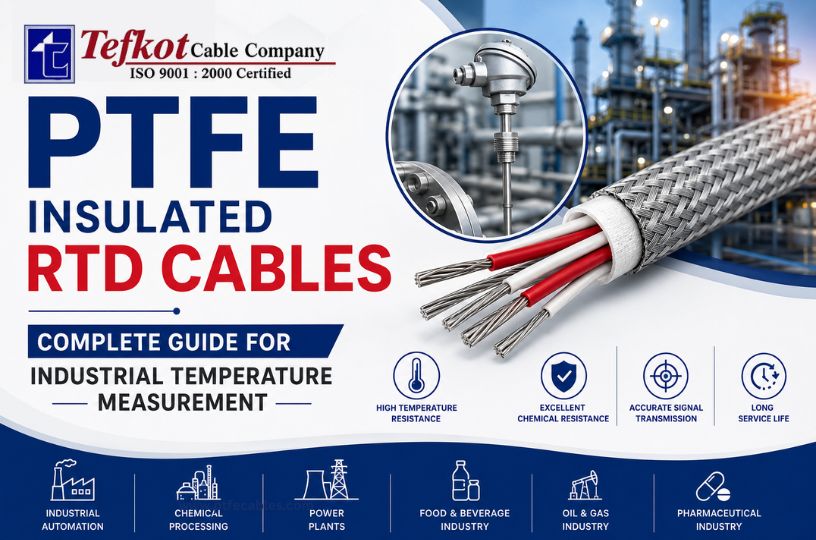
Accurate temperature measurement is essential across industries such as manufacturing, pharmaceuticals, food processing, chemical plants, power generation, and oil & gas. A small error in temperature monitoring can impact product quality, equipment efficiency, and operational safety.
This is where PTFE Insulated RTD Cables play a crucial role. Designed for high-temperature and harsh industrial environments, these cables ensure precise signal transmission between Resistance Temperature Detectors (RTDs) and monitoring instruments. Thanks to their excellent heat resistance, chemical stability, and electrical insulation, PTFE RTD Cables are widely used in applications where conventional cables cannot perform reliably.
In this blog, we’ll discuss what PTFE Insulated RTD Cables are, their construction, features, benefits, applications, and how to choose the right cable for industrial temperature measurement.
What are PTFE Insulated RTD Cables?
PTFE Insulated RTD Cables are specially designed cables used to connect Resistance Temperature Detectors (RTDs) with control panels, PLC systems, transmitters, and temperature monitoring devices. These cables are insulated using Polytetrafluoroethylene (PTFE), a high-performance fluoropolymer known for its exceptional resistance to heat, chemicals, moisture, and electrical stress.
Compared to standard insulated cables, PTFE Cables provide better signal integrity, longer service life, and reliable performance in demanding industrial environments.
What is an RTD?
An RTD (Resistance Temperature Detector) is a temperature sensor that measures temperature by detecting changes in the electrical resistance of a metal element, typically platinum (Pt100 or Pt1000).
RTDs are preferred in industrial applications because they offer:
- High measurement accuracy
- Excellent long-term stability
- Wide operating temperature range
- Repeatable performance
- Reliable temperature monitoring
The performance of an RTD depends significantly on the quality of the cable used, making PTFE Insulated RTD Cables the preferred choice for critical applications.
Construction of PTFE Insulated RTD Cables
A typical PTFE RTD cable consists of:
Conductors
High-quality annealed copper or tinned copper conductors for excellent conductivity.
PTFE Insulation
Each conductor is individually insulated with PTFE for superior heat and chemical resistance.
Shielding (Optional)
Braided shielding minimizes electrical noise and electromagnetic interference (EMI), ensuring accurate signal transmission.
Outer Jacket
A PTFE outer sheath provides additional protection against abrasion, chemicals, moisture, and high temperatures.
Key Features of PTFE Insulated RTD Cables
1. High Temperature Resistance
One of the biggest advantages of PTFE High Temperature Cables is their ability to operate continuously in temperatures ranging from -65°C to +260°C.
Suitable for:
- Furnaces
- Boilers
- Heat treatment plants
- Steel industries
- Glass manufacturing
2. Excellent Electrical Insulation
PTFE provides superior dielectric strength, helping transmit RTD signals accurately with minimal signal loss.
3. Chemical Resistance
PTFE insulation resists:
- Acids
- Alkalis
- Oils
- Solvents
- Fuels
- Corrosive chemicals
This makes PTFE RTD cables ideal for chemical and pharmaceutical industries.
4. Moisture & Weather Resistance
PTFE absorbs almost no moisture, ensuring stable electrical performance even in humid or outdoor environments.
5. Flame Retardant
PTFE is naturally flame resistant and produces very little smoke, enhancing safety in industrial installations.
6. Long Service Life
Thanks to its outstanding thermal and mechanical properties, PTFE insulation offers a significantly longer operational life compared to conventional cable insulation.
Benefits of PTFE Insulated RTD Cables
Using PTFE Insulated RTD Cables offers several advantages:
- Accurate temperature signal transmission
- Excellent thermal stability
- High resistance to chemicals and oils
- Reduced maintenance costs
- Longer cable lifespan
- Low signal interference
- Suitable for harsh industrial environments
- Improved equipment reliability
Applications of PTFE Insulated RTD Cables
PTFE RTD cables are widely used across industries where precise temperature measurement is essential.
Industrial Automation
- PLC systems
- Control panels
- Process automation
- Robotics
Chemical Processing Plants
Used for temperature monitoring in highly corrosive environments.
Oil & Gas Industry
Suitable for refineries, offshore platforms, and petrochemical facilities where high temperatures and harsh conditions are common.
Pharmaceutical Industry
Used in sterilization equipment, reactors, and manufacturing systems that require accurate temperature control.
Food & Beverage Industry
Supports temperature monitoring in ovens, cold storage, processing lines, and packaging systems.
Power Plants
Ideal for monitoring turbines, generators, transformers, boilers, and other high-temperature equipment.
Steel & Metal Industries
Used in furnaces, rolling mills, and heat treatment processes.
PTFE RTD Cables vs PVC RTD Cables
| Feature | PTFE RTD Cables | PVC RTD Cables |
|---|---|---|
| Temperature Resistance | Up to 260°C | Up to 70–105°C |
| Chemical Resistance | Excellent | Moderate |
| Electrical Insulation | Excellent | Good |
| Moisture Resistance | Excellent | Good |
| Flame Resistance | Excellent | Moderate |
| Service Life | Longer | Standard |
For high-temperature industrial environments, PTFE Insulated RTD Cables offer superior reliability and durability.
Related PTFE Cable Products
A reliable PTFE Cable Manufacturer typically offers a complete range of high-performance cable solutions, including:
- PTFE High Temperature Cables
- PTFE Wires
- PTFE Multicore Cable
- PTFE Insulated Multicore Cable
- PTFE High Voltage Cables
- PTFE Insulated Thermocouple Wire
- UL Approved Teflon Wire
- PTFE Sleeves
These products are designed to meet the diverse needs of industrial, electrical, and instrumentation applications.
How to Choose the Right PTFE RTD Cable
Before selecting a cable, consider the following factors:
Temperature Range
Ensure the cable can withstand your operating conditions.
Number of Cores
Choose 2-core, 3-core, or 4-core RTD cables based on the sensor configuration.
Shielding Requirement
Use shielded cables in electrically noisy environments to minimize interference.
Chemical Exposure
Select PTFE insulation for installations exposed to aggressive chemicals and oils.
Cable Flexibility
Flexible cables simplify installation in complex industrial setups.
Quality Standards
Always source cables from an experienced PTFE Cable Manufacturer that follows recognized quality standards.
Why Choose PTFE Insulated RTD Cables?
Industries rely on PTFE Insulated RTD Cables because they offer:
- Superior temperature resistance
- Accurate signal transmission
- High insulation strength
- Excellent durability
- Resistance to chemicals and moisture
- Long-term operational reliability
- Reduced maintenance requirements
These qualities make them the preferred choice for industrial temperature sensing systems.
Conclusion
When accurate temperature monitoring is critical, PTFE Insulated RTD Cables provide the reliability and performance needed for demanding industrial applications. Their exceptional resistance to heat, chemicals, moisture, and electrical interference ensures consistent signal transmission and long service life. Whether used in automation systems, chemical plants, power stations, or pharmaceutical manufacturing, these cables help maintain precise temperature control and improve operational efficiency.
Looking for High-Quality PTFE RTD Cables?
Tefkot Cable Company is a trusted manufacturer of PTFE Insulated RTD Cables, PTFE High Temperature Cables, PTFE Wires, PTFE Multicore Cables, PTFE High Voltage Cables, and PTFE Insulated Thermocouple Wires. With advanced manufacturing capabilities and a commitment to quality, Tefkot delivers reliable cable solutions for industrial automation, instrumentation, aerospace, medical, and process industries.
Contact Tefkot Cable Company today to find the ideal PTFE cable solution for your industrial temperature measurement and instrumentation requirements.