
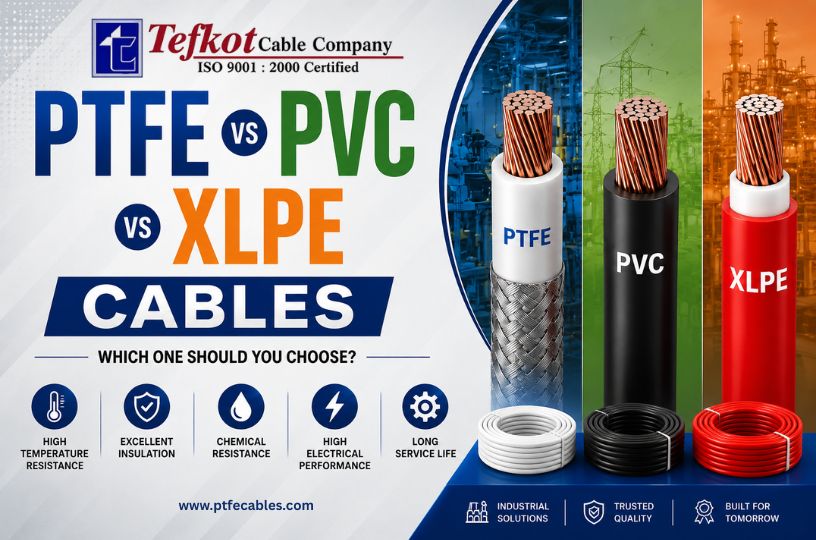
Choosing the right cable insulation material is critical for ensuring safety, durability, and reliable electrical performance. Whether you’re designing an industrial control system, manufacturing equipment, power distribution network, or high-temperature application, selecting between PTFE, PVC, and XLPE cables can significantly impact your system’s efficiency and lifespan.
Each insulation material has unique properties and is designed for specific environments. While PVC cables are cost-effective for general electrical applications, XLPE cables offer excellent mechanical strength and higher temperature resistance. However, for extreme operating conditions involving high temperatures, chemicals, and critical electrical performance, PTFE High Temperature Cables remain the preferred choice.
In this blog, we’ll compare PTFE Cables, PVC cables, and XLPE cables based on temperature resistance, durability, electrical properties, applications, and cost to help you choose the best option for your project.
What are PTFE Cables?
PTFE (Polytetrafluoroethylene) is a high-performance fluoropolymer used as insulation for electrical cables. Known for its exceptional thermal stability, chemical resistance, and electrical insulation, PTFE High Temperature Cables are widely used in demanding industries such as aerospace, defense, industrial automation, medical equipment, and instrumentation.
Common PTFE cable products include:
- PTFE Wires
- PTFE Multicore Cable
- PTFE Insulated Multicore Cable
- PTFE High Voltage Cables
- PTFE Insulated RTD Cables
- PTFE Insulated Thermocouple Wire
- UL Approved Teflon Wire
What are PVC Cables?
PVC (Polyvinyl Chloride) cables are among the most commonly used electrical cables for residential, commercial, and light industrial applications. They offer good insulation, flexibility, and affordability but have limitations in high-temperature and chemically aggressive environments.
PVC cables are commonly used in:
- Residential wiring
- Commercial buildings
- Lighting systems
- Electrical panels
- General-purpose wiring
What are XLPE Cables?
XLPE (Cross-Linked Polyethylene) is an upgraded insulation material that offers better thermal performance, higher current-carrying capacity, and improved mechanical strength compared to PVC.
XLPE cables are widely used for:
- Power transmission
- Underground cable networks
- Renewable energy projects
- Industrial power distribution
- Utility applications
PTFE vs PVC vs XLPE: Key Comparison
| Feature | PTFE Cables | XLPE Cables | PVC Cables |
|---|---|---|---|
| Operating Temperature | -65°C to +260°C | Up to 90°C (250°C short circuit) | Up to 70–105°C |
| Chemical Resistance | Excellent | Good | Moderate |
| Electrical Insulation | Excellent | Very Good | Good |
| Flame Resistance | Excellent | Very Good | Moderate |
| Moisture Resistance | Excellent | Excellent | Good |
| UV Resistance | Excellent | Good | Moderate |
| Mechanical Strength | Excellent | Excellent | Good |
| Flexibility | Excellent | Moderate | Good |
| Service Life | Very Long | Long | Moderate |
| Cost | High | Medium | Low |
1. Temperature Resistance
When operating in extreme temperatures, PTFE High Temperature Cables outperform both PVC and XLPE.
PTFE
- Continuous operation up to 260°C
- Performs well in freezing conditions
- Suitable for furnaces and high-heat environments
XLPE
- Continuous operation around 90°C
- Short-circuit temperature up to 250°C
PVC
- Suitable for temperatures up to 70–105°C
- Not recommended for high-temperature industrial applications
2. Chemical Resistance
Industrial environments often expose cables to oils, solvents, acids, and corrosive chemicals.
PTFE
Outstanding resistance to:
- Acids
- Alkalis
- Fuels
- Industrial chemicals
- Solvents
XLPE
Offers moderate resistance to chemicals.
PVC
Can degrade when exposed to aggressive chemicals over time.
3. Electrical Performance
Reliable electrical insulation is essential for industrial systems.
PTFE Cables
- Excellent dielectric strength
- Low signal loss
- Stable performance at high temperatures
XLPE
- Good insulation
- Suitable for power transmission
PVC
- Adequate for standard electrical wiring
4. Mechanical Durability
PTFE insulation resists cracking, aging, abrasion, and environmental stress, making it ideal for demanding industrial conditions.
XLPE also provides excellent mechanical strength, while PVC is more suitable for standard indoor applications.
5. Flexibility
PTFE remains flexible across a wide temperature range, making installation easier in complex routing applications.
PVC is flexible under normal conditions, whereas XLPE tends to be stiffer.
Industrial Applications
PTFE Cables
Ideal for:
- Aerospace
- Defense
- Medical equipment
- Robotics
- Industrial automation
- Chemical processing
- Semiconductor manufacturing
- High-temperature furnaces
- Laboratory equipment
XLPE Cables
Best suited for:
- Power transmission
- Distribution networks
- Renewable energy
- Underground cables
- Utility infrastructure
PVC Cables
Commonly used in:
- Residential buildings
- Commercial offices
- Lighting systems
- Household appliances
- Low-voltage installations
When Should You Choose PTFE Cables?
Choose PTFE High Temperature Cables if your application requires:
- Continuous high-temperature operation
- Chemical resistance0
- Flame resistance
- High electrical insulation
- Long service life
- Critical industrial performance
- Precision instrumentation
Products such as PTFE Multicore Cable, PTFE High Voltage Cables, PTFE Insulated RTD Cables, and PTFE Insulated Thermocouple Wire are specifically engineered for these demanding applications.
When Should You Choose XLPE Cables?
XLPE cables are ideal if you need:
- Higher current-carrying capacity
- Underground installation
- Medium and high-voltage power distribution
- Better thermal performance than PVC
- Cost-effective industrial power solutions
When Should You Choose PVC Cables?
PVC cables remain a practical option for:
- Budget-sensitive projects
- Residential wiring
- Commercial buildings
- General electrical installations
- Low-temperature environments
Advantages of PTFE Cables Over PVC & XLPE
- Withstands temperatures up to 260°C
- Superior electrical insulation
- Outstanding chemical resistance
- Excellent UV and weather resistance
- Low smoke and flame-retardant properties
- Longer operational lifespan
- Reduced maintenance costs
- Performs reliably in harsh industrial environments
Choosing the Right PTFE Cable Manufacturer
When investing in premium cable solutions, choosing a reliable PTFE Cable Manufacturer is just as important as selecting the right insulation material.
Look for manufacturers offering:
- High-quality PTFE Wires
- PTFE Multicore Cable
- PTFE High Voltage Cables
- PTFE Insulated RTD Cables
- PTFE Insulated Thermocouple Wire
- UL Approved Teflon Wire
- International quality standards
- Custom cable manufacturing
- Technical support
Conclusion
While PVC cables are ideal for everyday electrical installations and XLPE cables provide excellent performance for power distribution, PTFE High Temperature Cables are the best choice for applications that demand superior heat resistance, chemical protection, and long-term reliability. Their exceptional insulation properties and durability make them the preferred solution for industries where performance and safety are critical.
Looking for Premium PTFE Cable Solutions?
Tefkot Cable Company is a trusted manufacturer of high-performance PTFE Cables, PTFE Wires, PTFE Multicore Cables, PTFE High Voltage Cables, PTFE Insulated RTD Cables, and PTFE Insulated Thermocouple Wires. With advanced manufacturing capabilities and a commitment to quality, Tefkot delivers customized cable solutions for aerospace, industrial automation, medical, defense, and other demanding industries.
Get in touch with Tefkot Cable Company today to find the right PTFE cable solution for your specific application and ensure reliable performance in even the harshest operating environments.